TouchWorld: A Predictive and Reactive Tactile Foundation Model for Dexterous Manipulation


Abstract
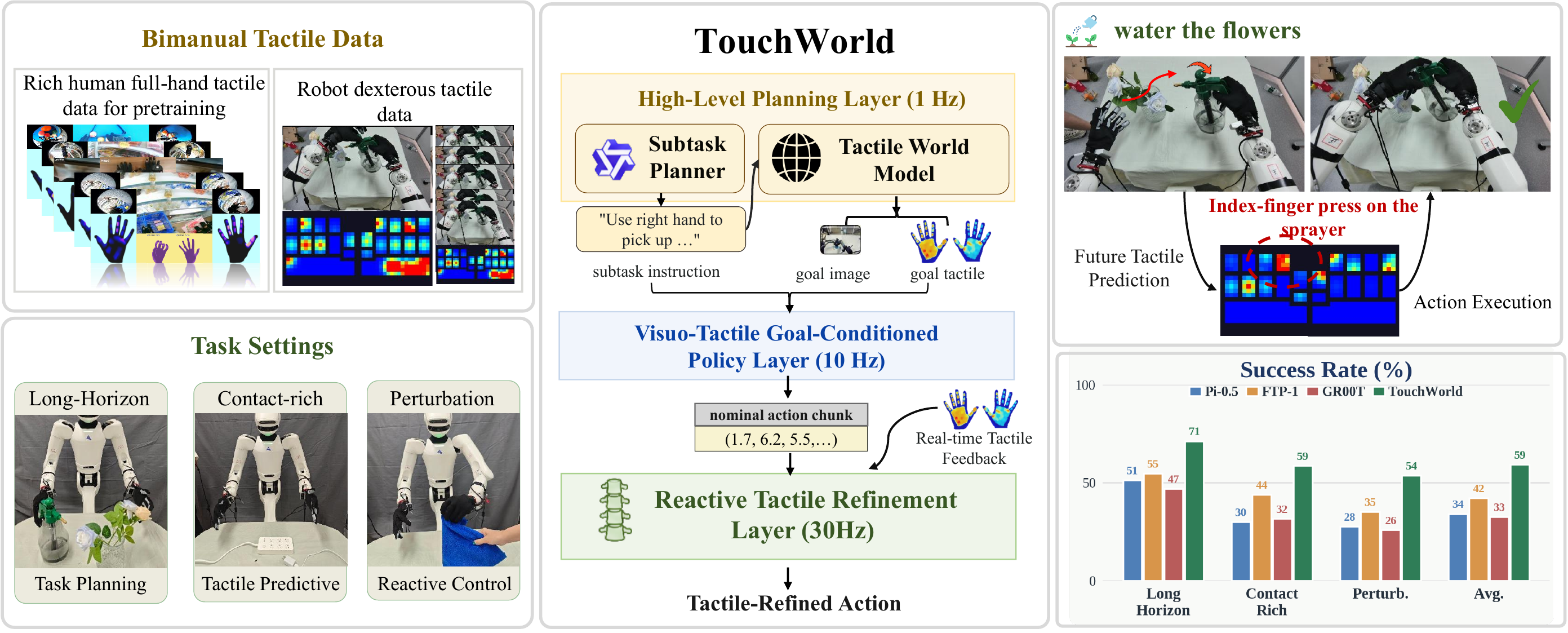
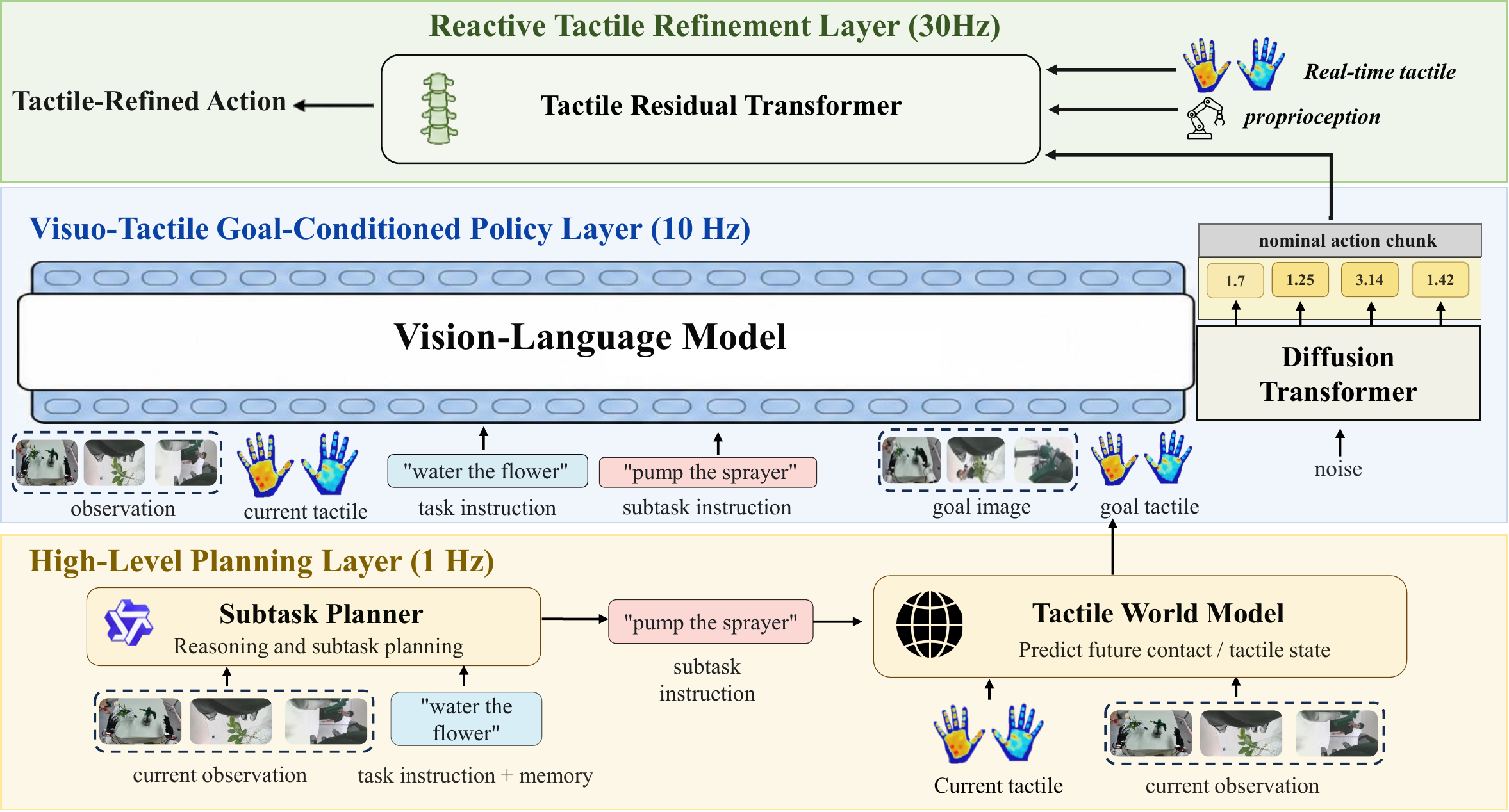
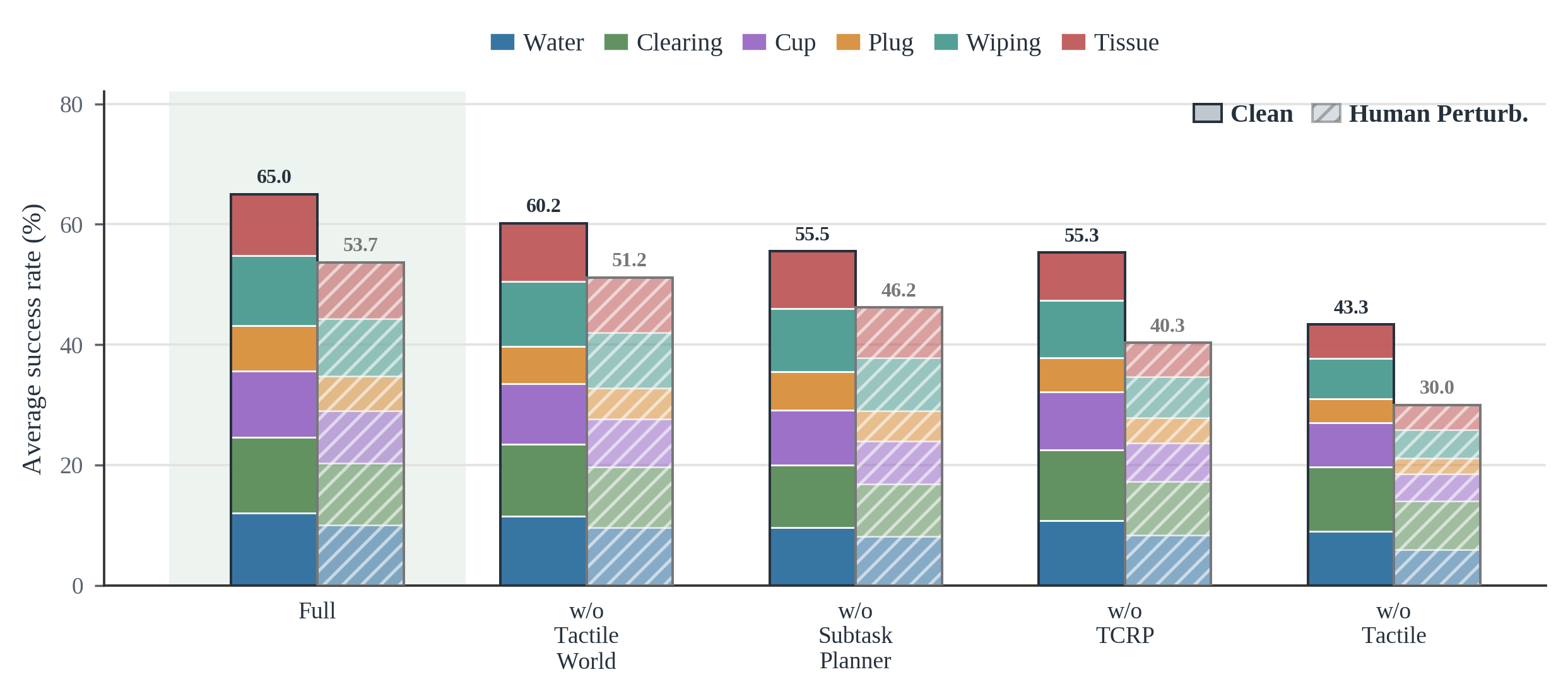
Dexterous manipulation in everyday environments requires both anticipation and reaction: a robot must predict how contact should evolve while rapidly correcting local errors caused by slip, misalignment, unstable grasping, or force mismatch. Vision and language provide semantic and geometric guidance, but they cannot reliably reveal hidden contact states such as force, slip, and contact stability. Although tactile sensing exposes these physical cues, most existing policies treat touch as a low-frequency observation stream within a monolithic action model, coupling slow task reasoning, action generation, and fast contact feedback in a single loop.We introduce TouchWorld, a predictive-and-reactive tactile foundation model for dexterous manipulation. TouchWorld uses a hierarchical policy that separates vision-language subtask planning, tactile world-model prediction, visuo-tactile goal-conditioned action generation, and high-frequency tactile residual refinement. A High-Level Planning Layer produces executable subtasks and predicts tactile subgoals; a Visuo-Tactile Goal-Conditioned Policy generates nominal action chunks; and a Tactile-Conditioned Refinement Policy performs online residual correction using recent tactile and proprioceptive feedback. By using touch as both a predictive contact reference and a fast feedback signal, TouchWorld preserves the semantic generalization of vision-language-action policies while improving local contact adaptation. Across six long-horizon and contact-rich dexterous manipulation tasks, TouchWorld achieves 65.0% success in the clean setting and 53.7% success under human perturbations, outperforming the strongest baseline by 15.7 and 18.5 percentage points, respectively.
Predictive and Reactive Tactile Policy
TouchWorld uses touch in two complementary ways: a predictive pathway anticipates future contact-aware goals, and a reactive pathway corrects local execution errors online. This keeps semantic reasoning, predictive goal generation, nominal action generation, and tactile feedback correction on separate time scales.
TouchWorld System
Robot Hardware and Tactile Interface
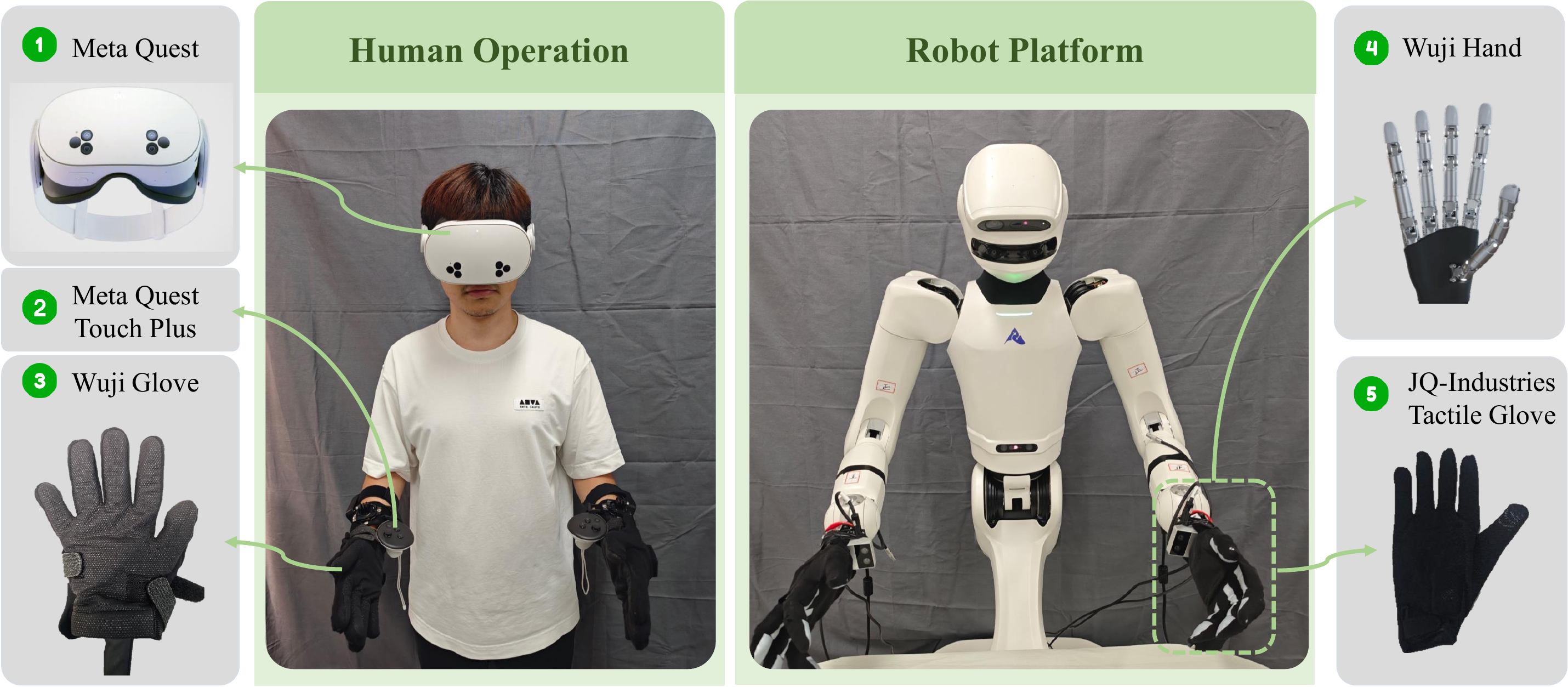
TouchWorld is evaluated on a humanoid platform equipped with Wuji dexterous hands and a JQ-Industries tactile glove. The teleoperation side uses a Meta Quest headset, Meta Quest Touch Plus controllers, and a Wuji Glove to collect synchronized visual, proprioceptive, action, and tactile demonstrations.
Tactile World Model Prediction
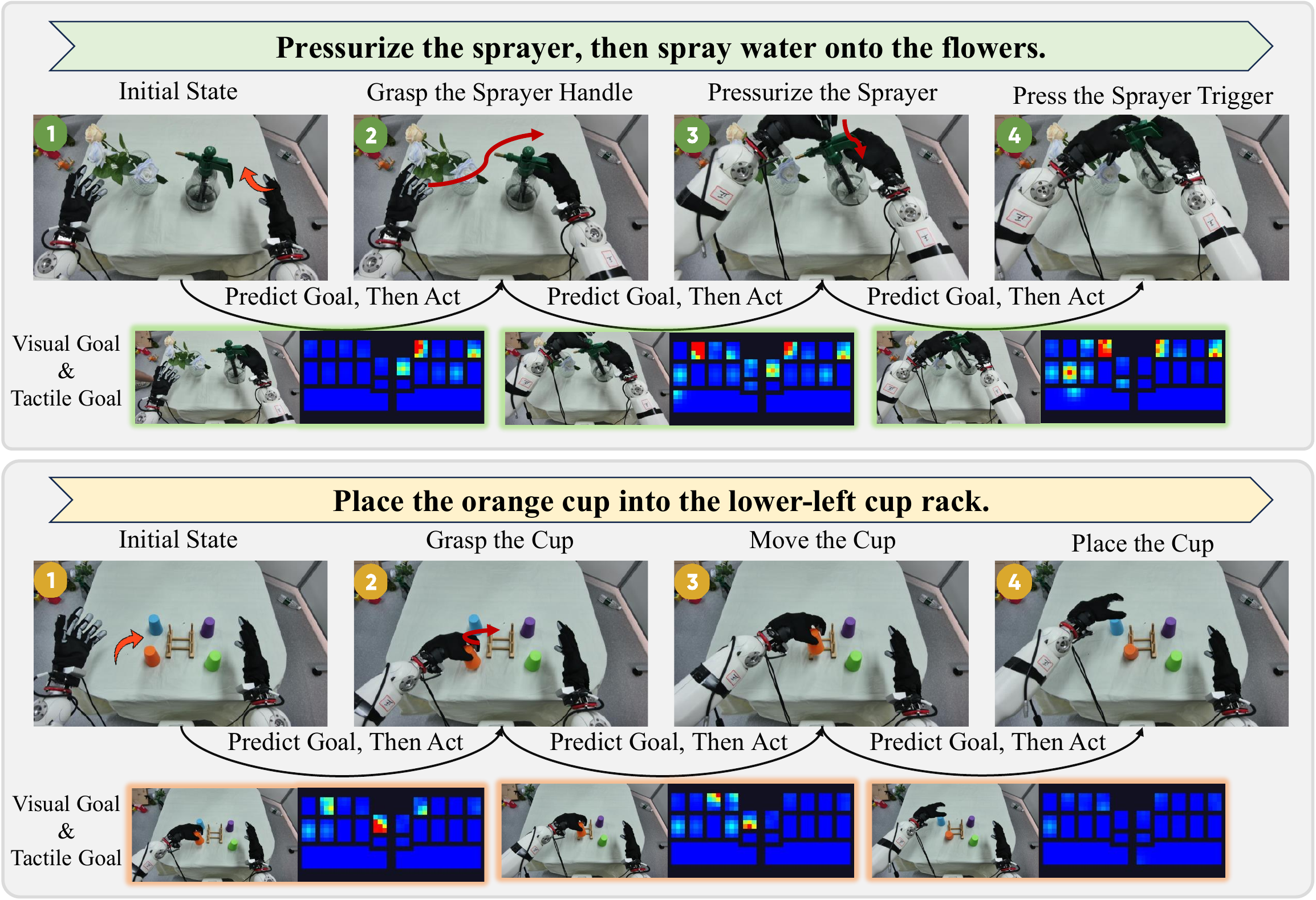
The Tactile World Model predicts future visual-tactile subgoals that describe the expected contact outcome of the current subtask. These predictions serve as contact-aware references for downstream action generation.
Tactile-Conditioned Refinement
The Tactile-Conditioned Refinement Policy operates faster than the nominal VLA policy. At each refinement step, it reads a sliding nominal-action lookahead window, recent tactile histories, and proprioception, then predicts a residual action correction.
Experiments
We evaluate TouchWorld on six real-robot tasks: Water Flower, Tabletop Clearing, Cup Insertion, Power Plug Insertion, Pot Wiping, and Tissue Pulling. Each task is evaluated in both a clean setting and a human perturbation setting.
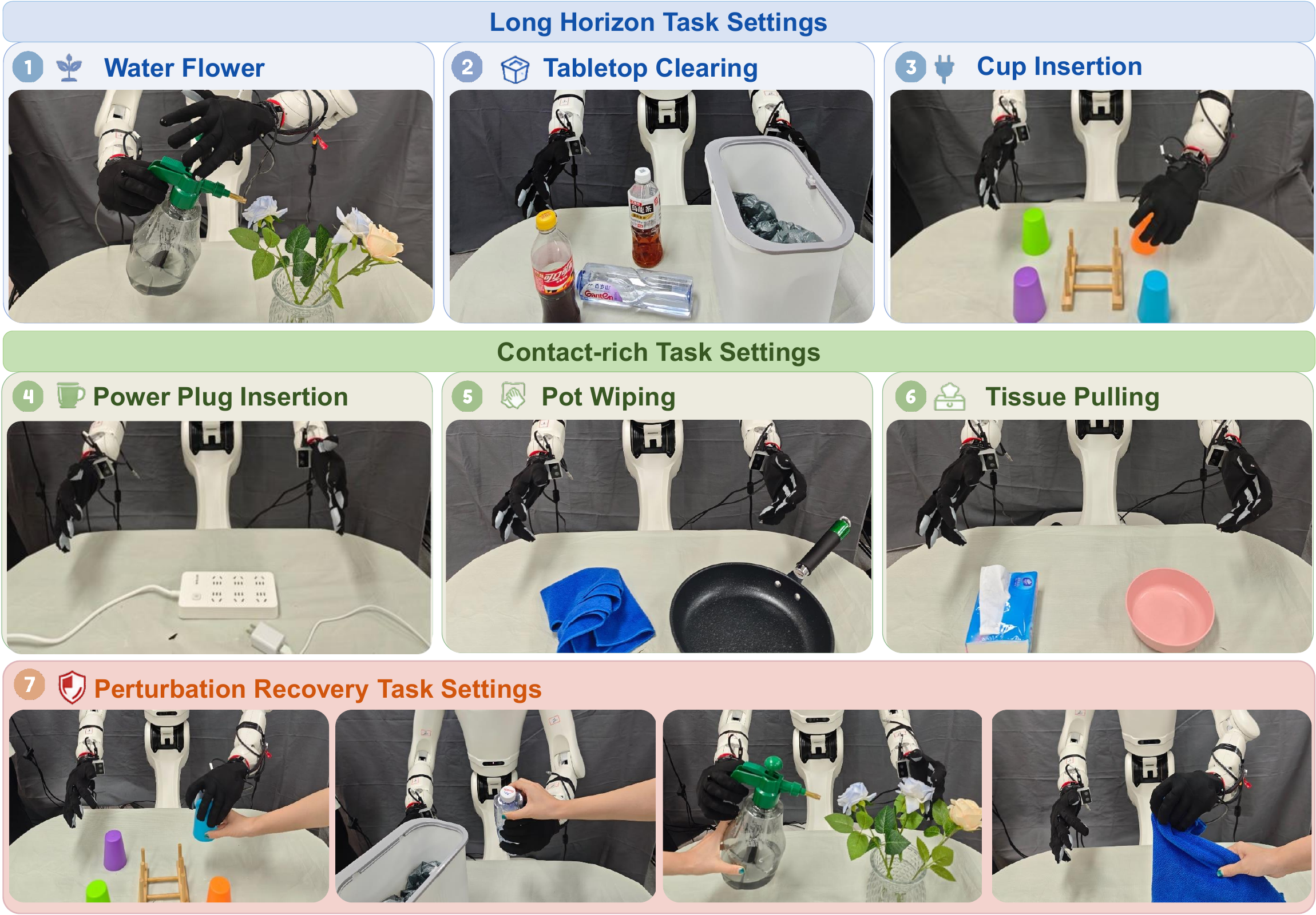
We also show representative teleoperated collection rollouts from the dataset. These clips are human-collected demonstrations rather than model inference outputs.
Human-collected demonstration rollouts
Pressure buildup and spray actuation over a long-horizon task.
Benchmark Results
TouchWorld consistently improves over Pi-0.5, FTP-1, and GR00T N1.7 across both clean and human-perturbed rollouts. The gains are especially clear on Power Plug Insertion, Pot Wiping, and Tissue Pulling, where tactile prediction and fast local correction are most important.
| Method | Water Flower | Tabletop Clearing | Cup Insertion | Power Plug Insertion | Pot Wiping | Tissue Pulling | Avg. |
|---|---|---|---|---|---|---|---|
| Clean Setting | |||||||
| Pi-0.5 | 52 | 66 | 36 | 12 | 39 | 39 | 40.7 |
| FTP-1 | 56 | 60 | 48 | 32 | 57 | 43 | 49.3 |
| GR00T N1.7 | 50 | 58 | 33 | 18 | 36 | 41 | 39.3 |
| TouchWorld | 72 | 76 | 66 | 45 | 70 | 61 | 65.0 |
| Human Perturbation Setting | |||||||
| Pi-0.5 | 34 | 44 | 24 | 6 | 28 | 30 | 27.7 |
| FTP-1 | 39 | 42 | 34 | 20 | 42 | 34 | 35.2 |
| GR00T N1.7 | 32 | 36 | 21 | 9 | 26 | 32 | 26.0 |
| TouchWorld | 60 | 62 | 52 | 35 | 57 | 56 | 53.7 |
Tactile World Model Evaluation
We visualize held-out Tactile World Model predictions by comparing the generated future visual-tactile subgoal with the corresponding ground-truth subgoal over the same subtask segment.
| Method | Temporal Contact Acc. | Contact IoU | Volumetric IoU |
|---|---|---|---|
| Current tactile copy | 70.4 | 31.8 | 24.6 |
| Nearest-neighbor subgoal | 77.5 | 39.2 | 31.0 |
| Tactile World Model | 86.3 | 52.7 | 43.8 |
Vision-Language Subtask Planner Analysis
The Subtask Planner receives the task instruction, current visual observations, and high-level memory, then emits an executable subtask for downstream policy conditioning. The memory-augmented planner improves subtask accuracy, execution success, and transition consistency.
| Planner | Subtask Acc. | Execution Success | Transition F1 |
|---|---|---|---|
| Zero-shot Qwen3-VL-4B | 43 | 34 | 62 |
| Zero-shot Qwen3-VL-32B | 69 | 54 | 71 |
| SFT Qwen3-VL-4B w/o Memory | 73 | 60 | 76 |
| Memory-Augmented SFT Qwen3-VL-4B | 88 | 65 | 82 |
Qualitative Inference Analysis
TouchWorld decomposes each instruction into executable intermediate subtasks and predicts tactile subgoals that provide contact-aware references for downstream action generation.
- The predictive pathway supplies contact-aware subgoals for stable long-horizon execution.
- The reactive pathway corrects local contact errors caused by slip, perturbation, or misalignment.
Limitations & Future Directions
Our real-robot evaluation focuses on six representative contact-rich tasks. These tasks cover planning, insertion, wiping, and soft-object handling, but they do not yet exhaust the diversity of household manipulation or deformable-object interactions.
TouchWorld is tied to the sensing layout used in our robot platform. Transferring to a different tactile sensor or hand morphology still requires calibration, normalization, and likely a small amount of adaptation data.
Acknowledgements
We thank the Harbin Institute of Technology, Shenzhen and PHANES AI teams for their support with the robot platform, data collection, and experiments.